Unit Economics & SIP Sizing Models (9 Guides)
Deep-dive mathematical models for every variable inside an AI voice agent invoice: concurrent RTP channels, talk-time character ratios, AMD waste, and regional Vultr compute.
9 Audited Engineering Guides
Concurrent SIP vCPU Math
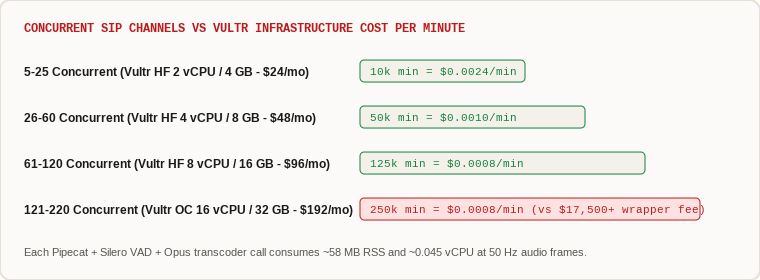
Each active Pipecat + Silero VAD + Opus pipeline consumes ~0.045 high-clock vCPU and ~58 MB RSS—making concurrency deterministic.
Speech-to-Output Ratio
An inbound support agent listening 65% of the call burns half the TTS characters of a scripted outbound pitch agent.
Deepgram Nova-2 STT
Deepgram Nova-2 bills strictly by audio stream duration (~$0.0043-$0.0059/min), making it less than half of wrapper STT rates.
LiveKit SIP Footprint
LiveKit Server + livekit-sip + Valkey fits comfortably under 1.2 GB RAM for 35 concurrent calls when run with host networking.
Telnyx vs Twilio SIP
Switching raw SIP termination from Twilio ($0.0085/min) to Telnyx ($0.0040/min) saves $2,700/yr at 50k minutes/month.
Outbound AMD Waste
When 55% of outbound calls hit carrier voicemail greetings, paying $0.12/min platform fees burns budget on empty greetings.
Barge-In TTS Waste
Generating 400 characters of ahead-of-playback TTS causes 30% credit waste whenever a caller interrupts mid-sentence.
Multi-Region RTP Jitter
Routing European callers through a US-West wrapper server adds 160ms round-trip audio lag before the AI even starts thinking.
36-Month Cash Ledger
Over a 36-month SaaS contract horizon, a 50,000-minute/mo voice fleet saves $156,600 by unbundling orchestration onto Vultr.